
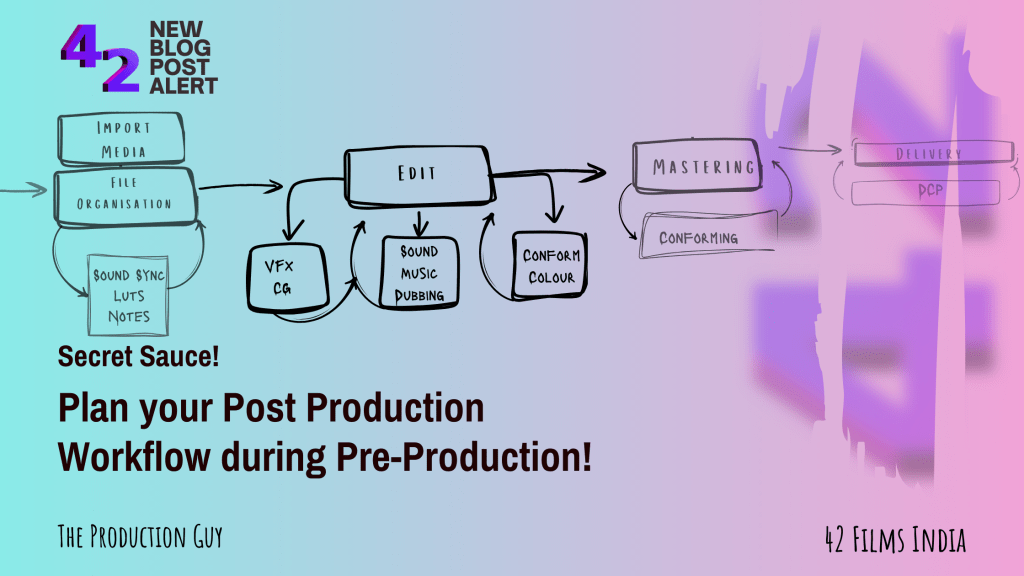
Post-production workflows are often one of the most overlooked aspects of pre-production. As everyone prepares for the demands of physical production, they tend to sideline post-production for the time being. This oversight leads to massive headaches during the post-production process. A simple yet effective way to counteract these issues is to prepare a solid post-production workflow during pre-production.
What is post-production workflow?
A post-production workflow is an operational schema; the process, stages, steps, and technical outline to be followed during the post-production stage of filmmaking. It involves many creatives (editors, sound designers, music directors, etc.) working systematically and simultaneously towards one goal.
Post-production is a chaotic period. The director and producer have to keep track of many processes and creatives working simultaneously, which can be tough to manage. Therefore, many large-scale projects have a specialized production coordinator just for the post-production process. The post-production coordinator follows up on all the stages of the post-production process, working closely with the department heads to manage any complications that may arise.
Planning the post-production process during the pre-production stage can be immensely useful for filmmakers. This holds especially true for large-scale projects, but it also applies to small-scale projects working on a shoestring budget. Projects shot in a run-and-gun manner usually require a detailed post-production workflow before they go into the shoot. This preparation informs their choices of camera, sound equipment, locations, in-camera vs post-production visual effects options, etc. Since small-scale projects might be unable to afford highly specialized post-production services, having a detailed blueprint for post-processes is paramount.
Let’s consider the benefits of this approach:
1. Enhanced Post-Production Efficiency:
When the entire post-production team aligns on workflow processes, it enables more accurate project timelines. With this clear timeline in mind, a producer can prepare to release the film or plan promotional events around the film’s expected completion date. The film won’t face unexpected delays!
2. Refinement of Production Requirements:
Test shoots under structured post-production workflows illuminate potential challenges early in filming. This foresight informs decisions on picture resolution, aspect ratios, and editing approaches, facilitating smoother production execution. The filmmakers won’t have to deal with bars and posts in the edit!
3. Consistency in Technical Specifications:
Preparing post-production workflows ensures uniformity in shooting formats, including codecs, resolution, and LUTs. This consistency helps achieve the intended visual and technical standards: this means that you end up filming exactly what you envisioned and are not surprised during the colour correction and mastering process by how the film looks.
4. Streamlined VFX Integration:
Well-defined workflows reduce uncertainties in VFX and CG phases, creating a more efficient pipeline from filming through post-production. With the workflow in place, the VFX coordinator can get the film’s set or actors ready during shooting. This makes it easier for VFX artists to work smoothly with the footage during post-production.
5. Collaborative Creative Input:
Early involvement of editors, sound designers, music directors, and department heads in pre-production enhances project planning and execution. Knowing which lenses will work best for a shot, how to film smooth transitions, and the pacing of music in action sequences helps tie the film together seamlessly.
In this article, we’re highlighting the benefits of planning a post-production workflow, focusing on everything except the sound and music stages. This is due to the prevalence of dubbing (or ADR as it’s called in the west) in the Indian film industry. However, it’s important to recognize that these benefits extend to sound and music too. From choosing the right microphones for shots, to creating foley effects, and setting the frame rate for sound mastering, early post-production planning improves every aspect of sound design and music.
The value of planning the post-production workflow during the pre-production stages cannot be underscored enough. Especially as many filmmakers lack an awareness of how consequential it can be, this area of the pre-production should be taught in more exhaustive detail to film students.
We hope you find this helpful! Feel free to reach out via comments or email for more insights.
 42 Films India
Leave a comment