
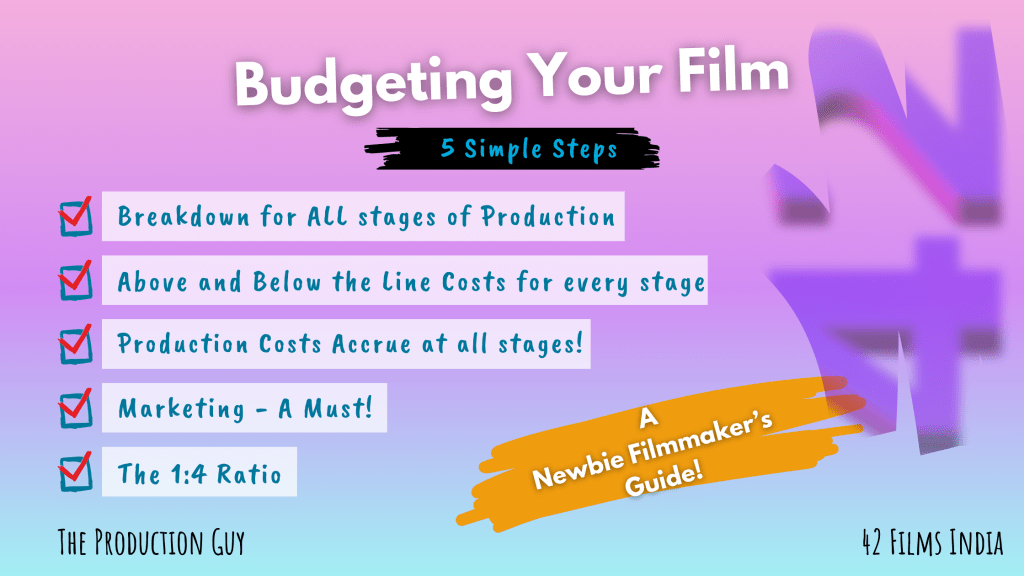
Great job completing your script! Now, let’s dive into estimating the film’s costs. Whether you’re new to budgeting or looking for a straightforward guide, these five steps will be incredibly helpful.
1. Include All Production Stages
Many new filmmakers only calculate production costs, forgetting pre-production and post-production entirely. Always break down your costs across all stages: pre-production, prep days, production, post-production, delivery, and marketing.
2. Differentiate Above-the-Line and Below-the-Line Costs
Once you’ve outlined the production stages, further categorize costs into above-the-line and below-the-line. Above-the-line costs cover key roles like actors, directors, caterers, and music directors who receive major payments. Below-the-line costs encompass crew such as lighting technicians, sound engineers, production assistants, dubbing sound mixers, and musicians.
3. Account for Production Costs at Every Stage
Factor in production costs and incidentals for each stage of filmmaking. Expenses like food, snacks, travel, trailers/changing rooms, stationery, and generators are essential throughout production. For special scenes like rain sequences, budget for umbrellas. If a dubbing studio is distant, include travel expenses for talent. Even minor needs like snacks for color technicians should be budgeted.
4. Allocate for Marketing
Don’t overlook marketing—a crucial budget item. Whether you aim to sell your film to a producer or submit it to festivals, allocate funds accordingly. The industry standard suggests setting aside about one-third of the total production cost. This covers expenses such as professional posters, TV and YouTube ads, newspaper ads, billboards, and film festival submissions.
5. Consider the 1:4 Shooting Ratio
When planning, remember the shooting ratio: for every minute of final film, you may need to shoot four times that amount of footage. For instance, creating a 10-minute film may require shooting 40 minutes of footage. Similarly, shooting efficiency is key—expect only a fraction of shot footage to make the final cut. If it takes one day to shoot 4 minutes of footage, typically only 1 minute of that footage will be used in the final edit.
Tip:
Don’t hesitate to reach out for quotes. Contact suppliers and service providers directly to accurately estimate costs for equipment and services needed.
Note:
While ‘above the line’ and ‘below the line’ costs are more commonly used terminologies in Hollywood rather than the Indian film industry, they provide a useful framework for distinguishing between major expenditures, such as cast and key crew, and daily operational costs.
 42 Films India
Leave a comment