Have you ever wondered how to make your screenplay’s pitch deck stand out from the crowd? What do you need to make a good pitch deck? Or have you just been confused between a pitch deck and a lookbook? Here is a quick dive into the three key differences between the two. After reading this article you can figure out which one your screenplay needs!
At 42 Films India, we often encounter individuals who struggle to understand what goes into creating a pitch deck or are confused about the difference between a pitch deck and a lookbook. To help clarify these concepts, especially in the context of Indian films, we decided to create a brief primer.
If you’re unsure about the difference, don’t worry—many professionals are in the same boat. The confusion arises because some agencies and producers use these terms interchangeably, while others make a clear distinction and might get annoyed if they are mixed up.
What is a Pitch Deck?
A film’s pitch deck is a concise presentation used by filmmakers to showcase their movie concept. It highlights key elements like storyline, characters, and visual style, aiming to persuade investors or studios to back the project.
Storydoc.com
What is a Lookbook?
A lookbook is a carefully crafted assembly of images that illustrates a creative’s vision for a movie or a TV show. It is usually put together inside a PDF document or bound book. It has a narrative flow and takes its reader through the project’s look, feel, and intended execution. It’s also sometimes called a “pitch deck.”
Nofilmschool.com
Despite these inherent similarities in both, there are distinctions between them. Let us take you through a few key elements.
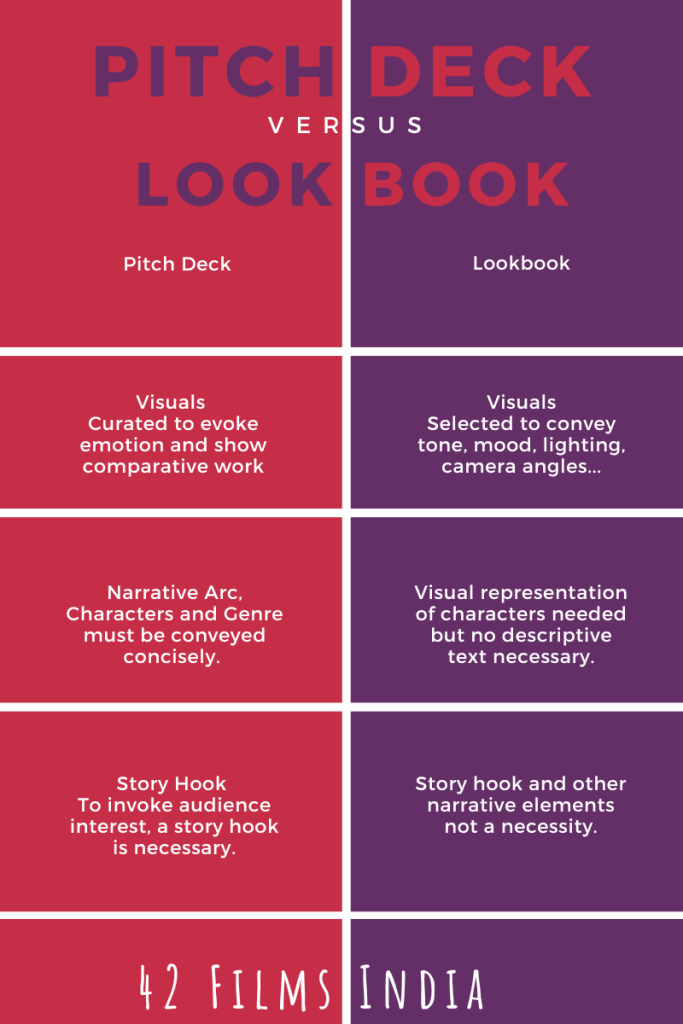
Pitch Deck Vs Lookbook
Visuals
This is the element that’s common to both lookbooks and pitch decks.
Both of these tools in a writer or producer’s repertoire contain stunning and poignant visuals. In a lookbook, the emphasis on the images is to convey tone, mood, colors and evoke emotions. In a pitch deck, however, the mission is to impart the story’s characters, narrative flow and filmmakers’ vision through the images.
There is also a difference in how many images one should include in a lookbook vs a pitch deck. You do not want to inundate your client with too many images in a pitch deck, you want to keep the whole deck brief, 6 to 8 pages for a feature film is the norm.
In a lookbook, especially if the lookbook is being created in collaboration with the director of photography or a producer for a feature film, the lookbook can easily be 15 pages long and just filled with images. This is because the director of photography is trying to convey his ideas on lighting and camera angles, the producer is aiming to showcase locations and casting options and the director is trying to convey everything else.
*We’re not going to address lookbooks in ad film contexts because that is a detailed topic and needs to have a write-up all by itself!
Narrative and Characters
A pitch deck has to necessarily contain the story arc and character descriptions whereas a lookbook does not need these elements.
When seeking interest from producers, financiers, and studios for your project, it’s crucial to give them a clear idea of the narrative arc and the major characters of the film. While you may also send them the script, having a short 5-page pitch dec/factsheet detailing the story synopsis and main characters is handy for them to keep referring back to.
Having a short synopsis and character details will also remind the producers or financiers that you have done the heavy lifting during the writing process. It will also serve as a quick reference guide for you when you are pitching your film to everyone, if you falter during a narration of the script, you can always refer back to this document and quickly get back on track.
These elements in a pitch deck have to be kept brief, you should not include your long synopsis in this document and you should keep each character descriptions within 100 words. This will allow for space for any reference images you want to include side by side.
Story hook
A story hook is a narrative writing element/technique. It’s a story plot point, opening action or inciting incident that hooks or captures the reader’s attention.
It will foreshadow to the audience what kind of dramatic action can be expected later in the story. The reason to incorporate it into your pitch deck is to elicit interest from its readers. You want the producers and financiers to wonder ‘what next?’ in the story.
This is crucial in any pitch deck because a pitch deck is often a ‘leave-behind’. (Leave-behinds are physical or soft copy pitching material that you usually send to a producer or ‘leave-behind’ with a financier after narrating the film.) So, whenever the readers of the pitch deck leaf through it, they will be kept wondering ‘what next?’ in the story. In a lookbook, the primary goal is to communicate the visual ideas of a story, more often than not, a story hook is not a visual element of the film and will not organically be communicated with just still images.
With these elements in mind, you can start making your pitch deck. We hope you have a better understanding of what a pitch deck and lookbook are through this introduction to them. There are also many pitch decks of famous movies and TV shows that a free and available online for you to go through in case you need to look at effective examples.
We hope this was helpful! Get in touch with us through the comments or email us for more!

 42 Films India
Leave a comment